


When starting an e-commerce platform selection process, we often see too much focus on the initial implementation costs, not giving a complete picture of the total costs over the next 3-5 years. A quote for building a new webshop is just the initial investment. Although the amount for licences for the initial construction phase seems attractive, it is often the recurring costs in the long term that significantly affect the total budget.
The real yardstick for a sustainable, successful e-commerce operation is the total cost of ownership (TCO). By calculating the TCO over a period of three to five years, the e-commerce manager or IT director gets a realistic and strategic picture of what the platform will really cost.
In this article, we explain what makes up TCO and show how the choice of architecture (SaaS or Self-hosted) affects the final cost structure.
What is the TCO and what costs can it consist of?
The TCO includes all direct and indirect costs associated with your e-commerce platform during its operational lifecycle. For a strategic decision, we recommend an analysis over a period of at least 3-5 years.
These costs are determined by key factors such as the complexity of the webshop (think of a complex B2B catalogue), the expected traffic and the necessary integrations with other business systems (ERP, PIM, CRM).
Differences between platforms: Open Source vs. SaaS/PaaS
Before we discuss costs in detail, it is crucial to understand that the choice of architecture - Open Source/Self-hosted versus SaaS (Software-as-a-Service)/PaaS (Platform-as-a-Service) - determines the structure of your TCO.
- SaaS/PaaS (e.g. Shopify): The platform provider manages hosting, updates and security. This leads to lower operational costs in terms of maintenance, but higher recurring licence/subscription costs and less flexibility in possible functionalities.
- Open Source/Self-hosted (e.g. Magento OS, Shopware Self-hosted): You (or your implementation partner) are responsible for hosting, maintenance and security. This leads to lower or no licensing costs for the core software, but costs are higher for performing updates and maintenance.
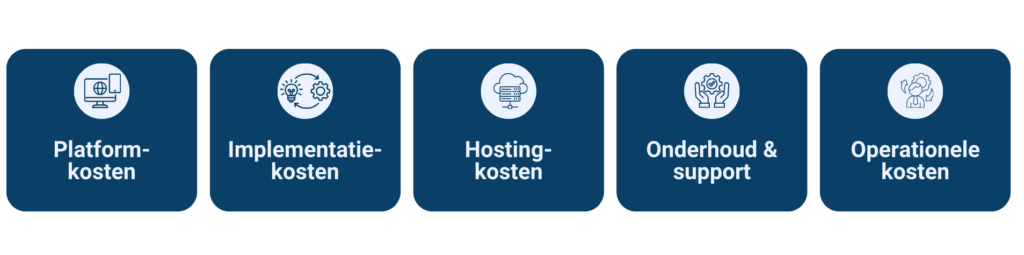
The 5 essential elements of TCO are:
- Platform costs: These are the costs of using the software itself. Think of licence fees (e.g. Shopify Plus) or any transaction fees that the platform charges. Many SAAS e-commerce platforms such as Shopify or Shopware work with a revenue-related licence fee. The more sales go through the platform the higher the monthly licence fee.
- Implementation costs: The one-off, but often largest, investment. This includes design, development hours, customisation, data migration, integrations with other business systems and project management.
- Hosting fees: The cost of the servers on which the web shop runs. Self-hosted platforms often require a hosting environment for both production and test environments.
- Maintenance & Support: This refers to recurring expenditure on updates, security patches and technical support. With self-hosted, these costs are often more variable than with SAAS because with SAAS, part of these costs are often included in the licence. However, the update costs of additional extensions and integrations, which often fall outside the standard licence costs of SAAS platforms, should be carefully considered here.
- Operational costs: These are costs that support day-to-day operations, such as monthly fees for apps and extensions (which can add up quickly in an ecosystem), themes and any payment provider fees (beyond the standard platform fees).
What determines TCO by architecture: SaaS vs. Self-hosted (Open Source/PaaS)
The choice of architecture is the main determinant of where your TCO budget goes. We compare the two main models:
SaaS (Software-as-a-Service)
- Definition: The software runs in the cloud and the vendor manages the servers, updates and security.
- Examples of SAAS platforms: Shopify, Shopware Cloud, Sana Commerce
- Advantage: You buy convenience and predictability. Time-to-market is short and there is minimal IT overhead.
- TCO Drivers:
- Subscription fees: Costs are directly linked to the plan you choose. They often increase with expected sales (Gross Merchandise Value) or the number of features required.
- Apps and Extensions: To compensate for the flexibility you lack, you often have to buy modules or apps. The cost of these, especially with a complex shop, can add up quickly and are a recurring operational expense.
- Integrations: Integrations can be a significant cost as updates to integrations are often not included in the licence fee.
- Transaction fees: Some SaaS platforms charge a percentage on your sales, unless you use their own payment provider e.g. Shopify.
- Conclusion: Low but rapidly rising entry costs. TCO is more predictable, but the cost of external functionality (apps) and revenue limits determine whether the cost is more advantageous than an open source solution.
Self-hosted / Open Source / PaaS (Platform-as-a-Service)
- Definition: You own the code yourself (Open Source) or rent the software via a PaaS (Platform-as-a-Service) and are responsible for hosting, customisation and maintenance.
- Illustrative Examples: Magento Open Source, Shopware Self-hosted.
- Advantage: Maximum flexibility and control. You can customise the software exactly to your complex B2B requirements or ERP integrations. You usually don't have to set monthly licence fees linked to your turnover (GMV), which can be an advantage in case of strong growth.
- TCO Drivers:
- Higher implementation costs with customisation: Customising functionalities specifically to an organisation's requirements is often time-intensive and therefore costly.
- Maintenance and support: The main recurring TCO drivers are costs for updates, patches, security and management of the server. However, this budget for maintenance and development must be put into perspective against the annual, revenue-related licence costsn that one pays at commercial SaaS platforms.
- Licence fee: Some open source packages also come with licence fees that depend on the functionalities used.
Conclusion: Low/no initial licensing costs (Open Source). A larger part of the TCO consists of platform development and maintenance costs. The strategic advantage is that, in many cases, these ‘high’ maintenance costs do not outweigh the annual licence fees that one pays to SaaS vendors based on turnover over the platform when scaling up. This provides freedom when scaling strongly.
As an organisation, how do you make the right choice?
Choosing an e-commerce platform is not about the lowest price on day one, but about the best value in the long run. Your choice depends on a number of strategic factors:
- Does a SAAS platform offer all the functionality I need to serve my customers?
- What is more important in the organisation. Predictability of costs or flexibility in functionalities for the customer?
- How do the costs of updates and maintenance compare with the licensing costs of the SAAS platform?
The three essential steps for an accurate TCO determination
To inform this strategic decision, you can take the following steps:
- Define the functional and technical requirements (Scope): Be precise in which B2B functionalities (quotations, price lists, order lists) and which integrations you absolutely need. This determines the scope of the customisation and therefore the cost, and also answers the question of whether a SAAS solution may be suitable.
- Get quotes from implementation partners: Get specialised agencies (agencies) to prepare quotes for each platform under consideration based on your exact requirements.
- Make a 3-5 year TCO calculation: Make a calculation of the TCO for the next 3-5 years. Use our sample TCO excel sheet to get a good overview of the expected costs over the next few years.
Conclusion?
No single platform is universally the ‘best’ or the ‘cheapest’. The best choice is the platform architecture that is most aligned with your company's unique needs, budget and growth strategy. With a TCO analysis, you can avoid costly surprises and make a solid, sustainable e-commerce decision. Should you need advice or help in making a particular choice please do not hesitate to contact us.
Want to calculate your total cost of ownership? Download our handy TCO calculator sheet below.
TCO calculation sheet
Determine the TCO (total cost of ownership) for your e-commerce platform.





 EN
EN  NL
NL  MK
MK